Details for A474122
True






Report
Report Current Image
- report the current image for inappropriate content
Your link has been copied!
Animal information
A474122
Located At: MSPCA - Adoption Center at Nevins Farm
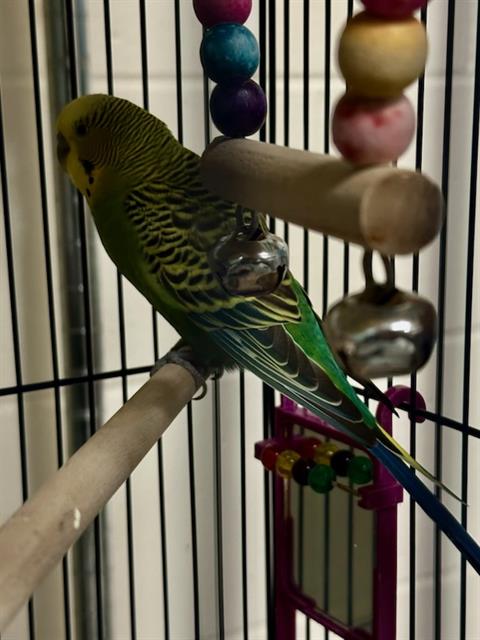
Description: My name is Franky.
I am a male, tricolor Parakeet.
I am a male, tricolor Parakeet.
Age: The shelter staff think I am about 1 year and 1 month old.
More Info: I have been at the shelter since Aug 11, 2026.
Meet Franky! Franky is a parakeet that would love to join your family. Although a little shy at first, with some quality time and treats, he'll make the perfect addition to any flock. Franky is housed with other companions, and would love to either go home with them or to a home that already has other feathered friends.
*Before coming to the adoption center, we ask that you have a housing unit ready, in case you end up finding an animal you’d like to adopt.
If you haven’t picked out an enclosure yet, we’d love to help! The Association of Avian Veterinarians has a chart on the minimum cage dimensions that are acceptable for housing the birds we commonly see in our adoption center. As a rule of thumb, get the largest cage you can provide—the bigger the better!
A few important recommendations
SIZE: Wire or mesh cages are preferred that are at least 1.5 to 2 times the wingspan of the bird in all directions. When a bird spreads both wings out, there should be enough room so the wings and tail are not touching any cage bars including top or bottom. The bird should be able to easily spin around on a perch without the tail hitting any cage bars including top/bottom of the cage. The cage should be big enough that the bird can fly with ease from the bottom of the cage to the top without the wings touching any cage bars or any other obstacles (like toys).
BAR SPACING: Make sure the spacing of the bars is small enough that your bird cannot escape! Select a finger or fingers that appear to be the same thickness as the bird’s wing. When checking bar spacing, if your finger or fingers (thickness) fits between the cage bar spacing, then the cage bar spacing is not proper for that bird (a bird could get harmed).
We suggest covering wire mesh platforms or bottoms with a layer of newspaper or other solid surface as exposed wire can cause abrasions to feet, as well as possibly catch and break toes and tails
Companion Birds should receive at least a half hour to an hour of interaction time with their human family; such as training, playing, and/or socially interacting.
For more wonderful information and resources please visit www.heartoffeathers.com
Meet Franky! Franky is a parakeet that would love to join your family. Although a little shy at first, with some quality time and treats, he'll make the perfect addition to any flock. Franky is housed with other companions, and would love to either go home with them or to a home that already has other feathered friends.
*Before coming to the adoption center, we ask that you have a housing unit ready, in case you end up finding an animal you’d like to adopt.
If you haven’t picked out an enclosure yet, we’d love to help! The Association of Avian Veterinarians has a chart on the minimum cage dimensions that are acceptable for housing the birds we commonly see in our adoption center. As a rule of thumb, get the largest cage you can provide—the bigger the better!
A few important recommendations
SIZE: Wire or mesh cages are preferred that are at least 1.5 to 2 times the wingspan of the bird in all directions. When a bird spreads both wings out, there should be enough room so the wings and tail are not touching any cage bars including top or bottom. The bird should be able to easily spin around on a perch without the tail hitting any cage bars including top/bottom of the cage. The cage should be big enough that the bird can fly with ease from the bottom of the cage to the top without the wings touching any cage bars or any other obstacles (like toys).
BAR SPACING: Make sure the spacing of the bars is small enough that your bird cannot escape! Select a finger or fingers that appear to be the same thickness as the bird’s wing. When checking bar spacing, if your finger or fingers (thickness) fits between the cage bar spacing, then the cage bar spacing is not proper for that bird (a bird could get harmed).
We suggest covering wire mesh platforms or bottoms with a layer of newspaper or other solid surface as exposed wire can cause abrasions to feet, as well as possibly catch and break toes and tails
Companion Birds should receive at least a half hour to an hour of interaction time with their human family; such as training, playing, and/or socially interacting.
For more wonderful information and resources please visit www.heartoffeathers.com
Data Updated: This information was refreshed 0 minutes ago.
Find a pet
Create favorites, search alerts, and more all in one place!
Create favorites, search alerts, and more all in one place!
Shelter information
Location: MSPCA - Adoption Center at Nevins Farm
Phone Number: (978) 687-7453
Address: 400 Broadway
Methuen, MA 01844
Methuen, MA 01844